Chuck
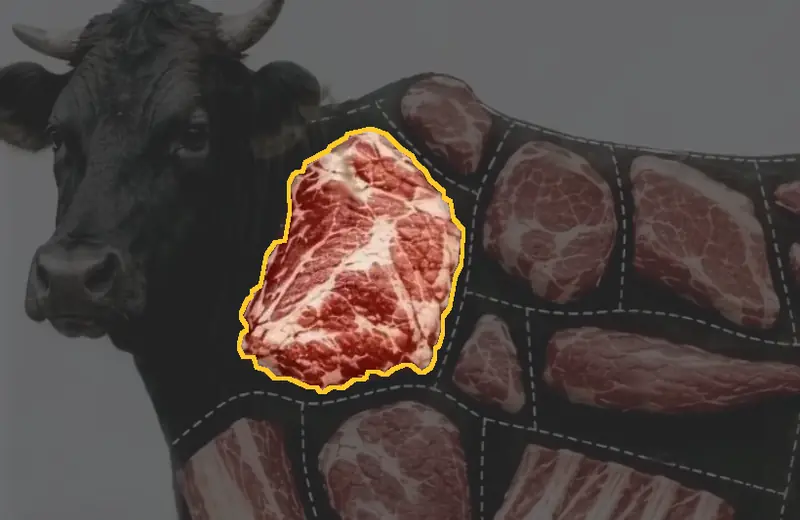
Chuck is the shoulder and neck section of beef, in front of the rib. Its muscles work hard, so the meat is flavourful, marbled and full of connective tissue. Most of it is slow-cooked or minced, but a few muscles make good steaks.
US: Chuck · UK: Chuck and blade · EU (NL): Schouder / onderrib · TR: Kürek
Quick facts
Primal: Chuck
Tenderness: Tough to fairly tender, depending on the muscle
Fat: Well marbled
Price: Budget
Best: Braise, smoke, mince
What is chuck called in other countries?
| United States | Chuck; chuck roast, pot roast, chuck roll, chuck eye |
|---|---|
| United Kingdom | Chuck and blade; braising steak; stewing steak |
| France | Basses côtes, paleron, macreuse (different shoulder muscles) |
| Germany | Hals / Nacken and Schulter (Bug) |
| Netherlands | Schouder; onderrib |
| Spain | Aguja (neck and chuck); espaldilla (shoulder) |
| Turkey | Kürek; gerdan (neck) |
| Trade codes | IMPS 113 (square-cut chuck), 116A (chuck roll) |
Names and cut lines vary by country and by butcher, so ask for the cut by description if the name doesn't match. Dutch and Turkish names are common butcher usage; there is no official Turkish retail cut standard. How we name cuts
Texture, fat and price
The chuck is a mix of many muscles. Some, like the chuck eye and the top blade (flat iron), are tender enough to grill; most need long, moist cooking. Its fat and collagen make it the best all-round cut for mince and burgers (around 80% lean), and a smoked chuck roast is a cheaper, quicker stand-in for brisket.
How to cook chuck
- Braise
- Smoke
- Stew
- Mince for burgers
- For pot roast or stew, cut into large chunks or keep whole, salt, and brown well in a heavy pot.
- Add onions, liquid (stock, wine or beer) to come halfway up, cover and cook at 150–160 °C for 3–4 hours.
- For a smoked chuck roast, cook at 120–135 °C (250–275 °F) and treat it like a small brisket: wrap at the stall and cook to probe-tender.
- Rest 20–30 minutes before slicing or pulling.
Chuck cooking temperatures
| Stage | Centre temperature |
|---|---|
| Sliceable (smoked) | around 88–91 °C (190–195 °F) |
| Pull-apart (smoked) | around 93–96 °C (200–205 °F) |
| Braised | until fork-tender, about 3–4 hours |
Slow-cooked chuck is done by feel. Minced beef must be cooked to at least 71 °C (160 °F) according to the USDA.
Chuck nutrition facts
Per 100 g, raw. USDA description: “Beef, chuck, blade roast, separable lean and fat, trimmed to 1/8" fat, all grades, raw”.
| Nutrient | Per 100 g |
|---|---|
| Energy | 248 kcal |
| Protein | 17.2 g |
| Total fat | 19.4 g |
| Saturated fat | 7.82 g |
| Cholesterol | 71 mg |
| Sodium | 68 mg |
| Iron | 2.04 mg |
Figures are for a chuck blade roast. Other chuck muscles differ: the arm pot roast is close, the chuck eye a little leaner.
Source: USDA FoodData Central, FDC ID 169493. Cooking removes water, so values per 100 g of cooked meat are higher. Actual values vary with the animal, grade and trim.
Recipes
Related cuts
Chuck Eye (the tender steak from the chuck) · Flat Iron (the second most tender beef muscle, also from the shoulder) · Brisket (the cut below the chuck)
Sources
- USDA Food Safety and Inspection Service, Safe Minimum Internal Temperature Chart.
- USDA Agricultural Marketing Service, Institutional Meat Purchase Specifications (IMPS), Series 100: Fresh Beef.
- USDA Agricultural Research Service, FoodData Central.