Chuck Eye
The chuck eye is the front end of the same back muscle that becomes the ribeye, cut from the chuck roll next to the 5th rib. Chuck eye steaks are often called the “poor man’s ribeye”: similar flavour and marbling, a little chewier, and much cheaper.
US: Chuck eye steak · UK: Chuck eye (part of chuck and blade) · EU (NL): Onderrib (part) · TR: no common name
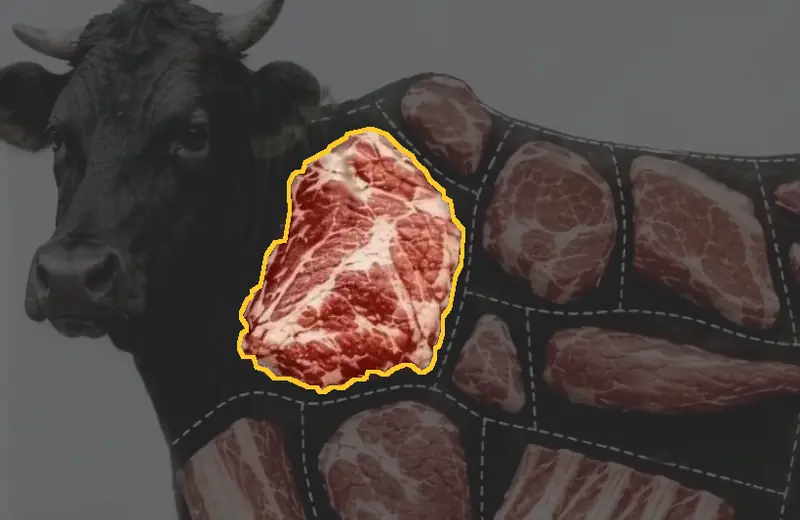
Quick facts
Primal: Chuck
Tenderness: Fairly tender
Fat: Well marbled
Price: Budget
Best: Grill, pan-sear, roast
What is chuck eye called in other countries?
| United States | Chuck eye steak; chuck eye roll (whole); chuck roll |
|---|---|
| United Kingdom | Part of the chuck and blade; sometimes sold as “chuck eye log” |
| Australia | Chuck eye roll |
| France | Basses côtes (the same area) |
| Germany | Roughly the Fehlrippe |
| Netherlands | Part of the onderrib |
| Turkey | No standard name |
| Trade codes | IMPS 116D (chuck eye roll) |
Names and cut lines vary by country and by butcher, so ask for the cut by description if the name doesn't match. Dutch and Turkish names are common butcher usage; there is no official Turkish retail cut standard. How we name cuts
Texture, fat and price
Only the first one or two steaks next to the rib are true chuck eye; further forward the muscle gets smaller and tougher, and other muscles join in. Ask the butcher for steaks from the rib end. Cooked medium-rare to medium, they are juicy and beefy, with a bit more chew than ribeye.
How to cook chuck eye
- Grill
- Pan-sear
- Roast whole
- Choose steaks at least 2.5 cm thick from the rib end of the chuck roll.
- Salt well and cook like a ribeye: hot pan or direct heat, turning every minute.
- Aim for medium-rare to medium; the extra fat needs a little more heat than a strip steak.
- Rest 5 minutes and slice across the grain.
Chuck Eye cooking temperatures
| Stage | Centre temperature |
|---|---|
| Rare | 49–52 °C (120–125 °F) |
| Medium-rare | 54–57 °C (130–135 °F) |
| Medium | 57–63 °C (135–145 °F) |
Take the meat off the heat 2–3 °C before your target; it keeps rising while it rests. The USDA's safe minimum for beef steaks and roasts is 63 °C (145 °F) with a 3-minute rest. Lower temperatures are common for steak but sit below that guideline.
Chuck Eye nutrition facts
Per 100 g, raw. USDA description: “Beef, chuck eye steak, boneless, separable lean and fat, trimmed to 0" fat, all grades, raw”.
| Nutrient | Per 100 g |
|---|---|
| Energy | 223 kcal |
| Protein | 18.9 g |
| Total fat | 16.4 g |
| Saturated fat | 6.96 g |
| Cholesterol | 68 mg |
| Sodium | 66 mg |
| Iron | 2.1 mg |
Figures are for chuck eye steak. USDA’s whole chuck eye roast (FDC ID 168660) is leaner: 180 kcal and 11.5 g fat per 100 g raw.
Source: USDA FoodData Central, FDC ID 171231. Cooking removes water, so values per 100 g of cooked meat are higher. Actual values vary with the animal, grade and trim.
Related cuts
Ribeye (the same muscle, a little further back) · Chuck (the section it comes from) · Flat Iron (another good-value shoulder steak)
Sources
- USDA Food Safety and Inspection Service, Safe Minimum Internal Temperature Chart.
- USDA Agricultural Marketing Service, Institutional Meat Purchase Specifications (IMPS), Series 100: Fresh Beef.
- USDA Agricultural Research Service, FoodData Central.