Brisket
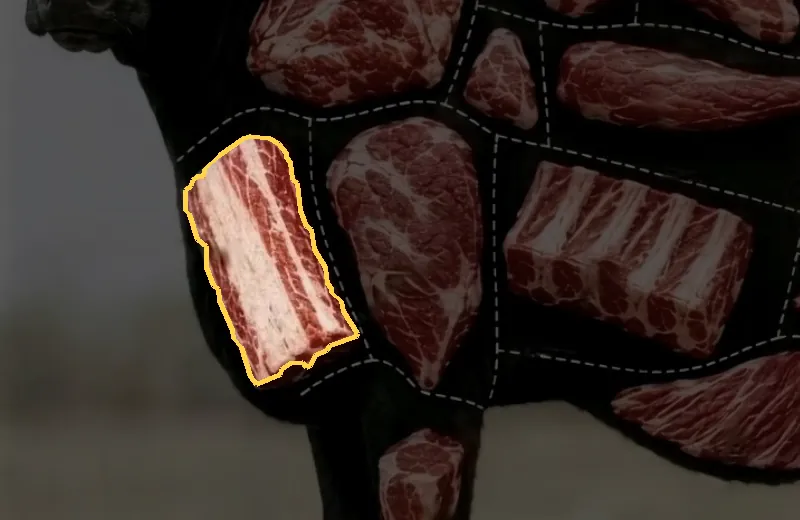
Brisket is a large, boneless cut from the lower chest (breast) of beef, in front of and between the front legs. It is tough and full of connective tissue, so it needs many hours of low heat. Cooked that way it becomes tender, juicy and is the heart of Texas barbecue.
Quick facts
Primal: Brisket
Tenderness: Tough until slow-cooked
Fat: High (point), medium (flat)
Price: Budget to mid
Best: Smoke, braise
What is brisket called in other countries?
| United States | Brisket. Whole: “packer” brisket, made of the flat and the point. |
|---|---|
| United Kingdom | Brisket |
| France | Poitrine |
| Germany | Rinderbrust |
| Netherlands | Borst or borststuk |
| Spain | Pecho |
| Turkey | Döş |
| Trade codes | IMPS 120 (brisket, boneless) |
Names and cut lines vary by country and by butcher, so ask for the cut by description if the name doesn't match. Dutch and Turkish names are common butcher usage; there is no official Turkish retail cut standard. How we name cuts
Texture, fat and price
A whole brisket is two muscles joined by a seam of fat. The flat is long, thin and leaner, and slices neatly. The point sits on top at one end; it is thicker and much fattier, and is used for burnt ends. Both carry a lot of collagen, which melts into gelatin with long cooking. Brisket is one of the cheaper cuts per kilo, but expect to lose a third or more of the weight in trimming and cooking.
How to cook brisket
- Smoke
- Braise
- Corned beef
- Oven, low and slow
- Trim the hard fat to about 6 mm and season well (salt and coarse black pepper is the Texas style).
- Smoke or cook indirectly at 110–135 °C (225–275 °F).
- When the centre stalls around 65–75 °C (150–170 °F) and the bark is set, wrap it in butcher paper or foil to push through.
- Cook until a probe slides into the thickest part of the flat like soft butter, usually around 93–96 °C (200–205 °F).
- Rest wrapped for at least 1 hour, then slice the flat across the grain about as thick as a pencil.
Brisket temperatures
| Stage | Centre temperature |
|---|---|
| Wrap (the stall) | 65–75 °C (150–170 °F) |
| Done: probe-tender | 93–96 °C (200–205 °F) |
| Slice after resting | 60–66 °C (140–150 °F) |
Cook brisket to feel, not to a number: some are tender a few degrees earlier, some later. Test the flat, not the point. These temperatures are far above the USDA safe minimum of 63 °C (145 °F).
Brisket nutrition facts
Per 100 g, raw: beef whole, lean and fat, trimmed to 1/8" fat, all grades.
| Nutrient | Per 100 g |
|---|---|
| Energy | 251 kcal |
| Protein | 18.4 g |
| Total fat | 19.1 g |
| Saturated fat | 7.5 g |
| Cholesterol | 69 mg |
| Sodium | 70 mg |
Source: USDA FoodData Central, FDC ID 168664. Cooking removes water, so values per 100 g of cooked meat are higher. Actual values vary with the animal, grade and trim.
Related cuts
Rib Plate (short ribs, also great smoked) · Chuck (another slow-cooking shoulder cut) · Navel Plate (used for pastrami and skirt steak)
Sources
- USDA Food Safety and Inspection Service, Safe Minimum Internal Temperature Chart.
- USDA Agricultural Marketing Service, Institutional Meat Purchase Specifications (IMPS), Series 100: Fresh Beef.
- USDA Agricultural Research Service, FoodData Central.