Flat Iron
Flat iron is a steak cut from the top blade muscle on the beef shoulder, with the tough sinew down its middle removed. After the tenderloin it is often called the most tender beef muscle, and it costs far less.
US: Flat iron · UK: Feather blade · EU (NL): Sukade · TR: no common name
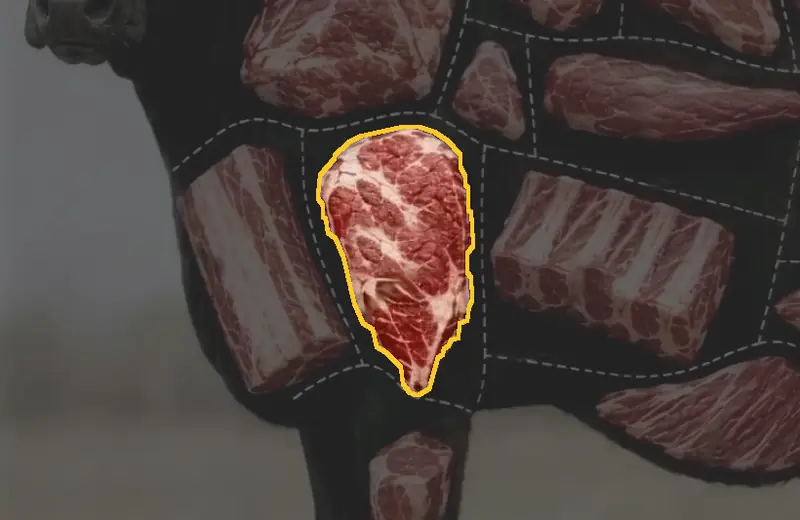
Quick facts
Primal: Chuck (shoulder clod)
Tenderness: Very tender
Fat: Good marbling
Price: Good value
Best: Grill, pan-sear
What is flat iron called in other countries?
| United States | Flat iron steak; top blade steak (cut across, with the sinew) |
|---|---|
| United Kingdom | Feather blade; flat iron |
| France | Paleron (whole muscle) |
| Netherlands | Sukade; sukadelappen are slices across the muscle, sinew included |
| Germany | Flat Iron Steak; the whole muscle is part of the Schulter (Bug) |
| Turkey | No standard name; sold as flat iron |
| Trade codes | IMPS 114D (shoulder clod, top blade), 1114D (top blade steak) |
Names and cut lines vary by country and by butcher, so ask for the cut by description if the name doesn't match. Dutch and Turkish names are common butcher usage; there is no official Turkish retail cut standard. How we name cuts
Texture, fat and price
The top blade has a thick band of gristle running through its centre. Cut along that line, each half becomes a flat, even, well-marbled steak. Cut across it, you get top blade steaks or Dutch sukadelappen, which have a strip of sinew in each slice and are better braised.
How to cook flat iron
- Grill
- Pan-sear
- Marinate
- Braise (sukadelappen)
- Flat iron steaks are thin and even, so they cook fast. Pat dry and salt.
- Sear over high heat for 2–4 minutes a side, to medium-rare or medium.
- Rest 5 minutes and slice across the grain.
- For slices with the sinew (sukadelappen), brown them and braise for 2–3 hours until the sinew turns soft.
Flat Iron cooking temperatures
| Stage | Centre temperature |
|---|---|
| Rare | 49–52 °C (120–125 °F) |
| Medium-rare | 54–57 °C (130–135 °F) |
| Medium | 57–63 °C (135–145 °F) |
Take the meat off the heat 2–3 °C before your target; it keeps rising while it rests. The USDA's safe minimum for beef steaks and roasts is 63 °C (145 °F) with a 3-minute rest. Lower temperatures are common for steak but sit below that guideline.
Flat Iron nutrition facts
Per 100 g, raw. USDA description: “Beef, chuck, shoulder clod, top blade, steak, separable lean and fat, trimmed to 0" fat, choice, raw”.
| Nutrient | Per 100 g |
|---|---|
| Energy | 182 kcal |
| Protein | 18.8 g |
| Total fat | 11.3 g |
| Saturated fat | 4.19 g |
| Cholesterol | 65 mg |
| Sodium | 74 mg |
| Iron | 2.23 mg |
Source: USDA FoodData Central, FDC ID 172125. Cooking removes water, so values per 100 g of cooked meat are higher. Actual values vary with the animal, grade and trim.
Related cuts
Chuck Eye (another good-value shoulder steak) · Hanger (another tender, flavourful “butcher’s cut”) · Chuck (the section it comes from)
Sources
- USDA Food Safety and Inspection Service, Safe Minimum Internal Temperature Chart.
- USDA Agricultural Marketing Service, Institutional Meat Purchase Specifications (IMPS), Series 100: Fresh Beef.
- USDA Agricultural Research Service, FoodData Central.