Short Ribs
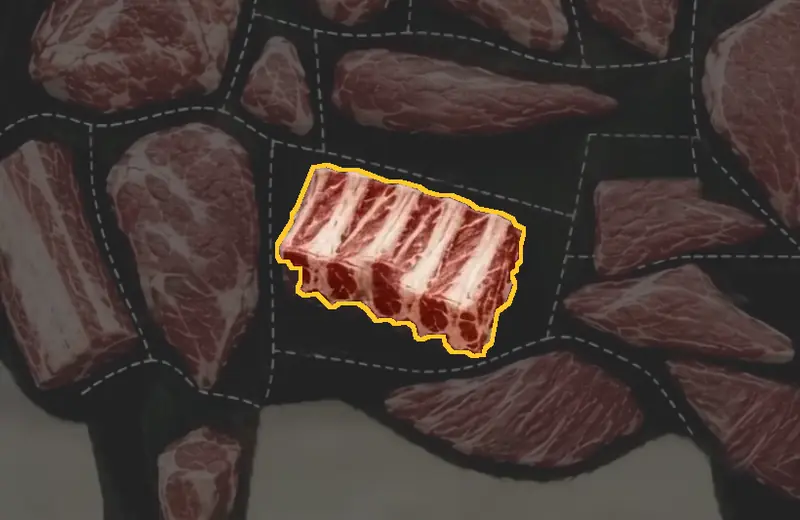
Short ribs are sections of beef rib bone with thick layers of meat and fat on top, cut from the lower ribs in the plate, chuck and rib. They are rich and tough, and turn meltingly tender when smoked or braised for hours.
US: Short ribs · UK: Jacob’s ladder · EU (NL): Klapstuk · TR: Kaburga
Quick facts
Primal: Plate and chuck
Tenderness: Tough until slow-cooked
Fat: High
Price: Mid
Best: Smoke, braise
What is short ribs called in other countries?
| United States | Short ribs. Plate short ribs (3-bone “dino ribs”), chuck short ribs. English cut (along the bone) or flanken cut (across the bones). |
|---|---|
| United Kingdom | Jacob’s ladder; short ribs |
| France | Plat de côtes |
| Germany | Querrippe; short ribs |
| Netherlands | Klapstuk (on the bone: short rib) |
| Argentina | Asado de tira (thin cut across the bones) |
| Korea | Galbi (thin flanken-style) |
| Turkey | Kaburga |
| Trade codes | IMPS 123 (short ribs), 123A (short plate, short ribs), 130 (chuck short ribs) |
Names and cut lines vary by country and by butcher, so ask for the cut by description if the name doesn't match. Dutch and Turkish names are common butcher usage; there is no official Turkish retail cut standard. How we name cuts
Texture, fat and price
Plate short ribs are the biggest, with long bones and a thick slab of meat; chuck short ribs are shorter with a little less meat. Both have plenty of marbling and connective tissue. Cooked low and slow, they become as rich as brisket point. A rack is mostly bone by weight, so allow about 500 g raw per person.
How to cook short ribs
- Smoke
- Braise
- Korean-style grill (thin cut)
- Trim the hard fat and the tough membrane on top. Season with salt and coarse pepper.
- Smoke: cook at 120–135 °C (250–275 °F) for 6–9 hours. Spritz if the surface looks dry.
- Braise: brown well, then cover with stock or wine and cook at 150–160 °C for about 3 hours.
- They are done when a probe slides in with almost no resistance, usually around 93–98 °C (200–208 °F). Rest 30 minutes.
Short Ribs cooking temperatures
| Stage | Centre temperature |
|---|---|
| Probe-tender (smoked) | 93–98 °C (200–208 °F) |
| Braised, falling off the bone | about 3 hours at 150–160 °C |
| Thin flanken cut, grilled | cook hot and fast, 1–2 minutes a side |
Like brisket, short ribs are done when tender, not at an exact number. These temperatures are well above the USDA safe minimum of 63 °C (145 °F).
Short Ribs nutrition facts
Per 100 g, raw. USDA description: “Beef, chuck, short ribs, boneless, separable lean and fat, trimmed to 0" fat, all grades, raw”.
| Nutrient | Per 100 g |
|---|---|
| Energy | 235 kcal |
| Protein | 17.5 g |
| Total fat | 18.3 g |
| Saturated fat | 7.98 g |
| Cholesterol | 75 mg |
| Sodium | 78 mg |
| Iron | 2.24 mg |
USDA has no raw entry for bone-in plate ribs. These figures are for boneless chuck short ribs.
Source: USDA FoodData Central, FDC ID 170826. Cooking removes water, so values per 100 g of cooked meat are higher. Actual values vary with the animal, grade and trim.
Recipes
Related cuts
Brisket (the other low-and-slow classic) · Plate (where the biggest short ribs come from) · Chuck (where chuck short ribs come from)
Sources
- USDA Food Safety and Inspection Service, Safe Minimum Internal Temperature Chart.
- USDA Agricultural Marketing Service, Institutional Meat Purchase Specifications (IMPS), Series 100: Fresh Beef.
- USDA Agricultural Research Service, FoodData Central.